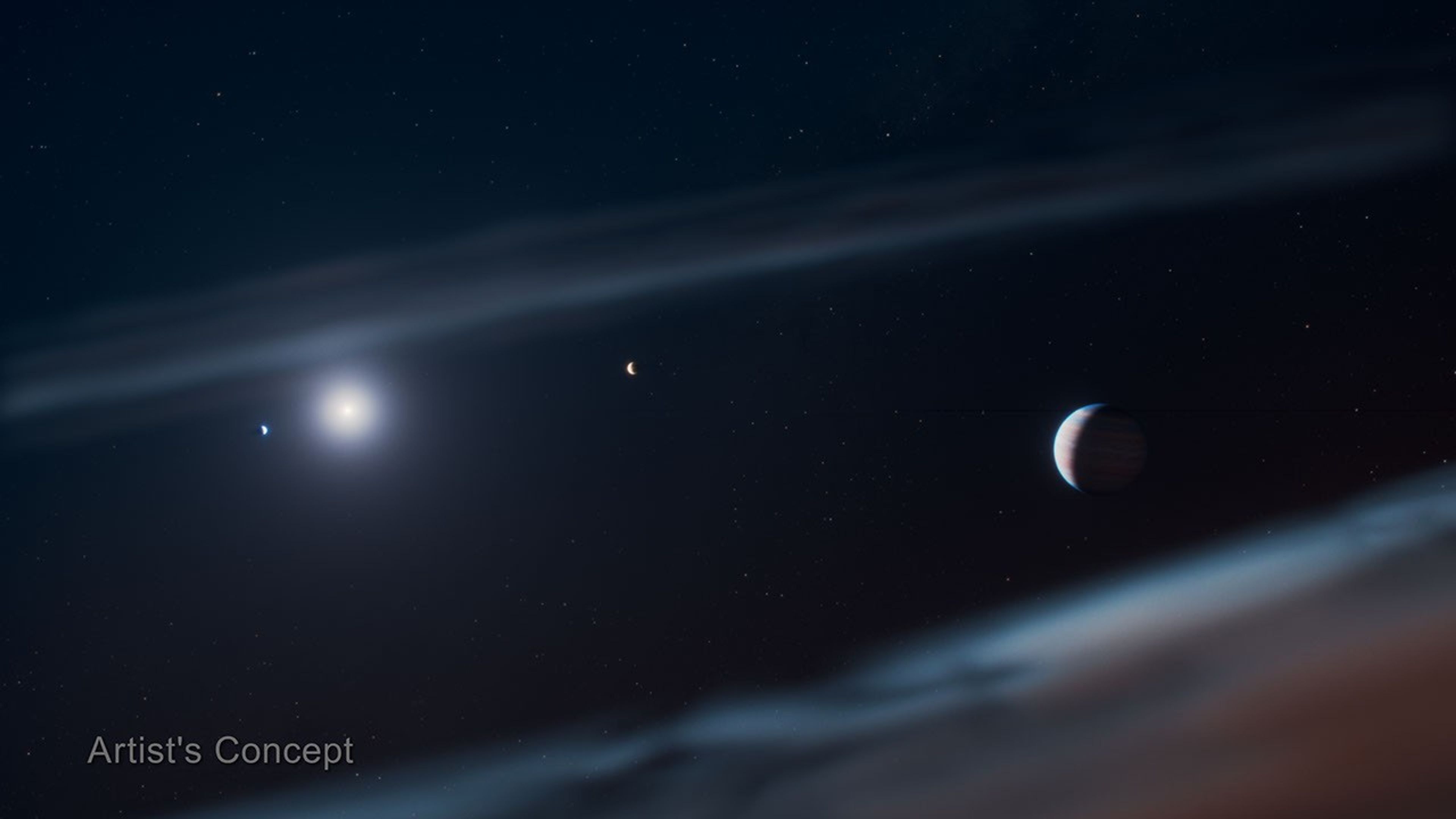
Astronomers have added a third known giant planet to the Beta Pictoris system, one of the closest and most intensely studied young planetary systems in the Milky Way. The new world, Beta Pictoris d, was announced after two independent research teams reached the same conclusion using different observing strategies.
One team found the planet with the James Webb Space Telescope while studying Beta Pictoris b, a previously known giant planet. Webb’s NIRSpec instrument did more than produce an image: it separated the light into a spectrum and revealed a molecular pattern associated with a planetary atmosphere. Carbon monoxide provided the first strong clue, while follow-up observations with Webb’s MIRI instrument detected water vapor and methane.
A planet identified by its atmosphere
The discovery is notable because Beta Pictoris d was not first recognized as a clean, bright point of light. The planet sits inside a luminous disk of dust and debris surrounding its star, where scattered starlight can imitate or hide faint objects. Instead of relying only on shape and brightness, researchers used spectroscopy to isolate the chemical fingerprint of the planet’s atmosphere.
This approach allowed the team to estimate the object’s motion and verify that it was orbiting Beta Pictoris rather than appearing by chance in the background. The result demonstrates that spectroscopy can uncover planets in environments where ordinary imaging struggles to separate real worlds from dust, glare, and instrumental artifacts.
Independent confirmation from Earth
A second team independently detected Beta Pictoris d using the ERIS instrument on the European Southern Observatory’s Very Large Telescope in Chile. The researchers then traced the planet through archival observations spanning more than a decade, strengthening the evidence that the object is gravitationally bound to the star and moving along a planetary orbit.
The two investigations broadly agree that Beta Pictoris d is a young gas giant with a mass of roughly two to four times that of Jupiter. Its orbit lies far outside those of the system’s two previously known giant planets, at approximately the distance occupied by the outer planets in our own solar system.
Current models place it near the inner edge of Beta Pictoris’s debris disk, suggesting its gravity may help shape the disk’s unusually sharp boundary.
A young system caught in transition
Beta Pictoris is only about 23 million years old, making it extremely young compared with the 4.6-billion-year age of our solar system. The star is surrounded by a broad disk of dust, gas, asteroids, and comet-like material left over from planet formation.
Because the system is nearby and viewed almost edge-on, astronomers can study how giant planets interact with the material around them. The addition of Beta Pictoris d makes this only the second planetary system known to contain at least three directly imaged planets.
That gives researchers an unusually detailed laboratory for testing how giant planets form, migrate, and reshape the disks from which they emerged.
What scientists will study next
Researchers still need more observations to refine the planet’s mass, temperature, atmospheric chemistry, and orbital period. Webb’s infrared instruments can continue measuring molecules in the atmosphere, while ground-based observatories can track the planet’s movement over time.
The discovery also points to a broader opportunity. Future searches may find additional planets not by waiting for a clear image, but by identifying molecular fingerprints hidden inside bright disks and stellar glare. That could expand direct planet detection into systems previously considered too complex for conventional imaging.